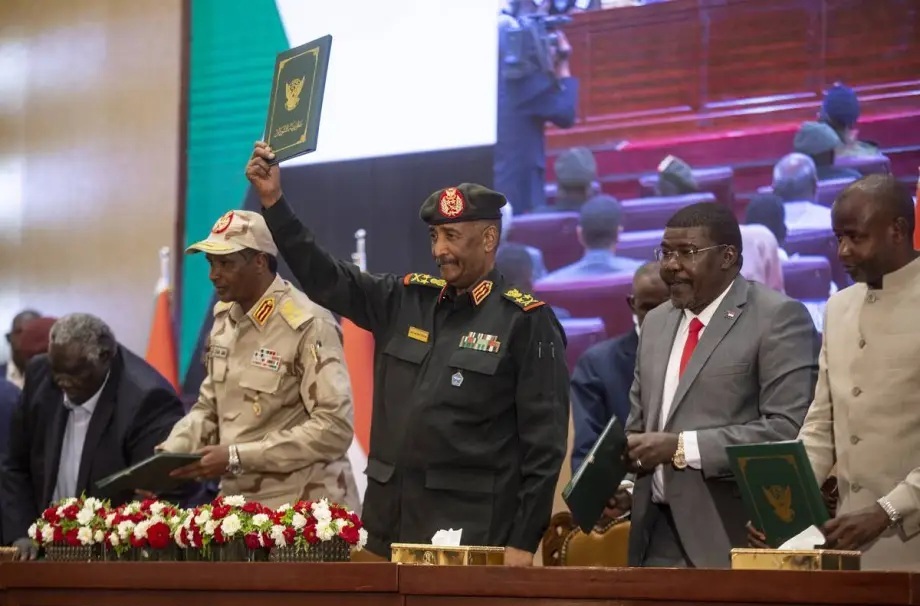
Less than two months after Sudan’s war began in April 2023, the then African Union (AU) Commission chair, Moussa Faki Mahamat, called it the ‘prototype’ for ‘African solutions to African problems’.
More than three years later, some of the most consequential diplomacy is taking place through processes that extend well beyond the continent: in Jeddah, Washington and through the Quad of the United States, Saudi Arabia, the United Arab Emirates and Egypt.
Africa has not been absent. On 23 September, the current AU Commission chair, Mahmoud Ali Youssouf, co-chaired with US envoy Massad Boulos the first joint meeting of the Quad and Quintet. The Quintet brings together the AU, the Intergovernmental Authority on Development (IGAD), the United Nations, European Union and the League of Arab States.
So the question is not where Africa is. It is why African diplomacy has struggled to make more of a difference. Part of the answer lies in the African mediation itself: competing initiatives and disagreements over who should lead and how the war should be handled. But there is another problem that no mediator has yet managed to overcome.
Khalid Omer Yousif, a former Minister of Cabinet Affairs in Sudan’s civilian-led transitional government, was part of the civilian leadership dealing with the military before the war. ‘Both sides intend to keep fighting until they achieve their political objectives,’ he says. ‘Neither has yet concluded that the table offers more than the battlefield, and as long as that holds, every negotiation is a pause for resupply.’ He says the problem predates the war. ‘From inside the negotiations, the central obstacle was clear: important military actors were not prepared to relinquish political power to a civilian authority. At the same time, Islamist networks remained deeply embedded in parts of the state and military establishment and saw a democratic transition as a threat to their return. The agreement on paper was often closer than the political will to implement it.’
Liesl Louw-Vaudran, the International Crisis Group’s Senior Adviser, African Union, points to an attempt by IGAD, the East African regional bloc, to bring the two sides together in December 2023.
She told me in a remote interview that, ‘IGAD came close to mediating between Burhan and Hemedti in December 2023, but that failed at the last minute’.
IGAD announced that General Abdel Fattah al-Burhan, head of the Sudanese Armed Forces (SAF), and Rapid Support Forces (RSF) commander Mohamed Hamdan Dagalo, known as Hemedti, had agreed to an unconditional ceasefire and a face-to-face meeting. Sudan’s foreign ministry disputed parts of the account, while the two sides also disagreed over the terms and format of any meeting. A source close to the talks told Sudanese media outlet Ayin Network that Burhan’s aides wanted the meeting limited to the two generals and Djibouti’s president, while Hemedti wanted IGAD leaders present as witnesses. The meeting never happened.
But Louw-Vaudran believes the problem with African mediation went beyond this failed attempt.‘I think the lacklustre response by the AU and IGAD has more to do with institutional weakness than what most people realise,’ she says. According to Louw-Vaudran, Moussa Faki established an expanded mechanism to deal with Sudan, but the AU Peace and Security Council believed it undermined its authority. At the same time, IGAD leaders believed the crisis should fall to them under the AU’s principle of subsidiarity. ‘In the end, the disagreements among the various IGAD leaders (Ruto, Kiir, Abiy, Museveni) also hampered any progress,’ she says.
General Abd al-Fattah al-Burhan of the SAF and General Mohamed Hamdan Dagalo (‘Hemedti’) of the RSF – who were allies before the current war – both wish to negotiate from a position of strength.
In June 2024, the AU Peace and Security Council directed that a panel of African heads of state, led by Ugandan President Yoweri Museveni, be set up to facilitate discussions between Burhan and Hemedti. But it went nowhere. ‘Neither the panel nor the extraordinary AU summit on Sudan, proposed by Museveni ever took place,’ Louw-Vaudran says.
African states are not necessarily neutral. Dr Yassine El Yattioui, an assistant professor at Lumière Lyon 2 University and expert on African politics and international relations, says their positions are shaped by ‘national security concerns, border stability, economic interests, and relationships with external powers.’
Egypt, for example, has close ties to SAF and regards developments in Sudan as a national security issue. Conversely, the UN’s fact-finding mission reported in September that it had reasonable grounds to believe a transnational network linking individuals and entities in the UAE, Chad, southeastern Libya and Puntland in Somalia supplied the RSF with weapons, equipment, logistics and personnel. It also found evidence that foreign-supplied drones had expanded SAF’s long-range strike capabilities. The UAE has repeatedly denied supporting the RSF militarily.
The mediators are not operating outside these competing interests. They are operating in the middle of them.
There is also the question of how much leverage African mediators actually have. ‘The fundamental difficulty lies in the asymmetry between institutional legitimacy and material leverage,’ El Yattioui told us. ‘The AU and IGAD possess significant regional legitimacy as mediating institutions, yet they lack sufficiently powerful coercive mechanisms, financial incentives, or military instruments to fundamentally alter the calculations of the belligerents.’
But is coercion really the job of a mediator? A mediator does not necessarily need its own drones or billions of dollars. The 1992 Mozambique peace process, for example, relied on mediators who built trust between the parties, while other governments provided political pressure and leverage when it was needed. The harder question in Sudan is whether African mediators can persuade the states that do have leverage to use it towards the same outcome.
Saudi Arabia has shown what that leverage can look like. Earlier this year, Reuters reported that Pakistan put a $1.5 billion arms deal with Sudan on hold after Saudi Arabia objected to it. But Riyadh has also put its weight behind Sudan’s army. The two positions are less contradictory than they appear: support for the army does not have to mean supporting a military solution, and a close ally is often best placed to apply pressure. Saudi Arabia is also part of the Quad pushing for a truce.
In June, Washington proposed a 90-day humanitarian truce followed by negotiations for a permanent ceasefire and a civilian-led transition. The army-led authorities have continued to insist on an internationally monitored RSF withdrawal from urban areas.
But the positions may not be quite as fixed as they appear. Diplomatic sources told Ayin Network that the army’s withdrawal demand was a negotiating position rather than a final condition and that talks had narrowed to technical arrangements around El Obeid, a strategically important city in central Sudan.
Both sides, however, still hold territory they believe strengthens their hand. The army recaptured the capital, Khartoum, in 2025. The RSF captured al-Fashir, the army’s last major stronghold in Darfur, later that year. In responding to the US plan, the army-led government insisted that the RSF withdraw from cities it had occupied, while the RSF rejected the demand, arguing that these were military gains.
‘Both military sides still appear to believe that further gains on the battlefield can be converted into political power,’ Yousif says. ‘As long as they retain weapons, resources, and external channels of support, they will continue to bet on a military outcome.’
His solution is to make fighting less worthwhile.
‘Three things would change the calculation. First, cut the war’s supply arteries for all parties — weapons from outside, gold from inside. Second, refuse to legitimise any outcome produced by force: no recognition, no seat, no normalisation for a government or authority installed by military gains. Third, make the political path the only route to power, so that what cannot be won at the table cannot be won anywhere.’
There is some leverage closer to home. Sudan has remained suspended from the AU since the 2021 coup. Louw-Vaudran says member states are divided over whether it should be allowed back, but the AU’s own rules on unconstitutional changes of government currently prevent that.
But refusing to recognise political outcomes imposed by force raises another problem: who then represents Sudan at the political table?
Yousif wants ‘a single coordinated mechanism that brings the Quad and the Quintet together – and with Sudanese civilian forces present as a party, not as an audience.’ The problem is that there is no single civilian body with an uncontested popular mandate. Sudan’s main civilian coalition, Taqaddum, split in 2025 over whether to participate in a parallel government in RSF-controlled areas
Attempts to convene civilians have repeatedly run into the same argument: who gets invited? When the AU and IGAD held a preparatory meeting for an inter-Sudanese dialogue in July 2024, Taqaddum and other major groups boycotted it amid concerns about transparency and the possible participation of figures associated with the National Congress Party of former president Omar al-Bashir, who ruled Sudan for three decades until he was ousted in 2019.
But there is another question: what exactly is a peace agreement supposed to restore?
Yousif argues that mediators underestimate the survival of Islamist networks associated with Omar al-Bashir’s former regime.
‘The National Congress Party was dissolved on paper in 2019; the Islamic Movement was not. Its networks kept their positions inside the security and intelligence services, the military-economic companies, the judiciary and the civil service. That structure was never dismantled — it went quiet, then re-emerged.’ The army denies coordinating with any political party, and Burhan has repeatedly said the NCP will not return to power.
But for Yousif, this is why treating Sudan simply as a fight between two generals is not enough. ‘Treat it as a bilateral fight between two generals over power, and coordinated leverage – however well-assembled – delivers a ceasefire that restores the pre-war structure and guarantees the next war. We have had that settlement before, more than once.’
El Yattioui says Sudan does not invalidate the principle of ‘African solutions to African problems’. It exposes the limits of applying ‘an exclusively continental diplomatic framework to a conflict whose political economy, military supply chains, and geopolitical alignments extend far beyond the African continent.’
The AU appears to recognise that. Its September meeting with the Quad and Quintet called for stronger coordination, an end to external military support and a shared roadmap linking humanitarian action, cessation of hostilities and civilian dialogue.
But bringing everyone into the same room will only matter if it changes the calculation of the people doing the fighting. The AU can suspend states after unconstitutional changes of government. African governments can act against supply networks operating through their territory and continue to push for civilians to have a meaningful role in any political process. But none of that amounts to much leverage unless these efforts are co-ordinated and the powers outside Africa are pushing in the same direction.
Until the warring parties believe the table offers them more than the battlefield, another diplomatic forum will not be an African solution. It will simply be another meeting.