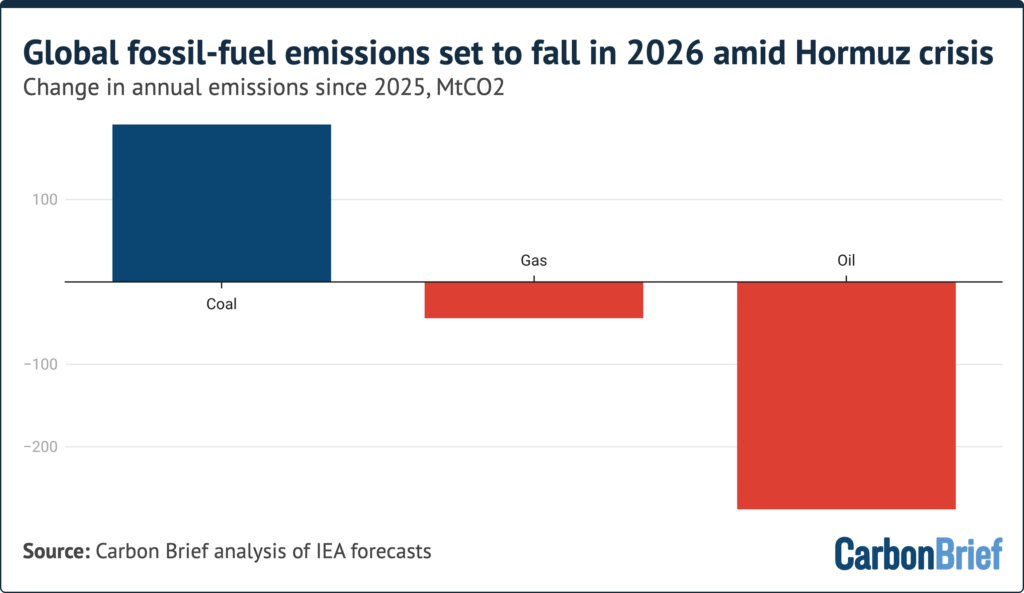
Global fossil-fuel emissions are set to fall by around 0.5% in 2026 amid the fallout from the Hormuz crisis, according to Carbon Brief analysis.
The US-Iran war has severely disrupted trade through the strait of Hormuz, causing a spike in oil and gas prices that continues to ripple around the global economy.
Each month of disruption – and each new flashpoint, such as in Yemen – is increasing the incentive to switch to alternatives.
Those alternatives include coal, with the latest forecasts pointing to a 1.2% rise in coal demand this year – apparently supporting media claims of a “return to coal” in the wake of the crisis.
Yet Carbon Brief’s analysis shows the rise in emissions associated with this increased coal use, much of which is unrelated to Hormuz, is set to be more than offset by declines for oil and gas.
The estimated overall impact on carbon dioxide (CO2) emissions from fossil fuels in 2026 is shown in the figure below and amounts to a reduction of around 0.5% from 2025 levels.
(Fossil fuels account for two-thirds of global greenhouse gas emissions.)
The emissions estimates for each fossil fuel are based on the latest forecasts from the International Energy Agency (IEA) for coal, oil and gas, in light of the ongoing global energy crisis.
For example, the agency initially estimated that global coal demand would decline this year. In its 2025 coal report, published in mid-December, it said that declining coal demand in China would outweigh the impact of pro-coal policies under US president Donald Trump.
In contrast, the latest update, published in September 2026, said that global coal demand would rise by 1.2% in 2026, instead of the small decline that had been expected.
The report highlighted the boost to coal demand from higher gas prices in the wake of Hormuz. However, there are limits to this, because few countries can switch from gas to coal at large scale.
var gform;gform||(document.addEventListener(“gform_main_scripts_loaded”,function(){gform.scriptsLoaded=!0}),document.addEventListener(“gform/theme/scripts_loaded”,function(){gform.themeScriptsLoaded=!0}),window.addEventListener(“DOMContentLoaded”,function(){gform.domLoaded=!0}),gform={domLoaded:!1,scriptsLoaded:!1,themeScriptsLoaded:!1,isFormEditor:()=>”function”==typeof InitializeEditor,callIfLoaded:function(o){return!(!gform.domLoaded||!gform.scriptsLoaded||!gform.themeScriptsLoaded&&!gform.isFormEditor()||(gform.isFormEditor()&&console.warn(“The use of gform.initializeOnLoaded() is deprecated in the form editor context and will be removed in Gravity Forms 3.1.”),o(),0))},initializeOnLoaded:function(o){gform.callIfLoaded(o)||(document.addEventListener(“gform_main_scripts_loaded”,()=>{gform.scriptsLoaded=!0,gform.callIfLoaded(o)}),document.addEventListener(“gform/theme/scripts_loaded”,()=>{gform.themeScriptsLoaded=!0,gform.callIfLoaded(o)}),window.addEventListener(“DOMContentLoaded”,()=>{gform.domLoaded=!0,gform.callIfLoaded(o)}))},hooks:{action:{},filter:{}},addAction:function(o,r,e,t){gform.addHook(“action”,o,r,e,t)},addFilter:function(o,r,e,t){gform.addHook(“filter”,o,r,e,t)},doAction:function(o){gform.doHook(“action”,o,arguments)},applyFilters:function(o){return gform.doHook(“filter”,o,arguments)},removeAction:function(o,r){gform.removeHook(“action”,o,r)},removeFilter:function(o,r,e){gform.removeHook(“filter”,o,r,e)},addHook:function(o,r,e,t,n){null==gform.hooks[o][r]&&(gform.hooks[o][r]=[]);var d=gform.hooks[o][r];null==n&&(n=r+”_”+d.length),gform.hooks[o][r].push({tag:n,callable:e,priority:t=null==t?10:t})},doHook:function(r,o,e){var t;if(e=Array.prototype.slice.call(e,1),null!=gform.hooks[r][o]&&((o=gform.hooks[r][o]).sort(function(o,r){return o.priority-r.priority}),o.forEach(function(o){“function”!=typeof(t=o.callable)&&(t=window[t]),”action”==r?t.apply(null,e):e[0]=t.apply(null,e)})),”filter”==r)return e[0]},removeHook:function(o,r,t,n){var e;null!=gform.hooks[o][r]&&(e=(e=gform.hooks[o][r]).filter(function(o,r,e){return!!(null!=n&&n!=o.tag||null!=t&&t!=o.priority)}),gform.hooks[o][r]=e)}});
gform.initializeOnLoaded( function() {gformInitSpinner( 7, ‘https://www.carbonbrief.org/wp-content/plugins/gravityforms/images/spinner.svg’, false );jQuery(‘#gform_ajax_frame_7’).on(‘load’,function(){var contents = jQuery(this).contents().find(‘*’).html();var is_postback = contents.indexOf(‘GF_AJAX_POSTBACK’) >= 0;if(!is_postback){return;}var form_content = jQuery(this).contents().find(‘#gform_wrapper_7’);var is_confirmation = jQuery(this).contents().find(‘#gform_confirmation_wrapper_7’).length > 0;var is_redirect = contents.indexOf(‘gformRedirect(){‘) >= 0;var is_form = form_content.length > 0 && ! is_redirect && ! is_confirmation;var mt = parseInt(jQuery(‘html’).css(‘margin-top’), 10) + parseInt(jQuery(‘body’).css(‘margin-top’), 10) + 100;if(is_form){jQuery(‘#gform_wrapper_7’).html(form_content.html());if(form_content.hasClass(‘gform_validation_error’)){jQuery(‘#gform_wrapper_7’).addClass(‘gform_validation_error’);} else {jQuery(‘#gform_wrapper_7’).removeClass(‘gform_validation_error’);}setTimeout( function() { /* delay the scroll by 50 milliseconds to fix a bug in chrome */ jQuery(document).scrollTop(jQuery(‘#gform_wrapper_7’).offset().top – mt); }, 50 );if(window[‘gformInitDatepicker’]) {gformInitDatepicker();}if(window[‘gformInitPriceFields’]) {gformInitPriceFields();}var current_page = jQuery(‘#gform_source_page_number_7’).val();gformInitSpinner( 7, ‘https://www.carbonbrief.org/wp-content/plugins/gravityforms/images/spinner.svg’, false );jQuery(document).trigger(‘gform_page_loaded’, [7, current_page]);window[‘gf_submitting_7’] = false;}else if(!is_redirect){var confirmation_content = jQuery(this).contents().find(‘.GF_AJAX_POSTBACK’).html();if(!confirmation_content){confirmation_content = contents;}jQuery(‘#gform_wrapper_7’).replaceWith(confirmation_content);jQuery(document).scrollTop(jQuery(‘#gf_7’).offset().top – mt);jQuery(document).trigger(‘gform_confirmation_loaded’, [7]);window[‘gf_submitting_7’] = false;wp.a11y.speak(jQuery(‘#gform_confirmation_message_7’).text());}else{jQuery(‘#gform_7’).append(contents);if(window[‘gformRedirect’]) {gformRedirect();}}jQuery(document).trigger(“gform_pre_post_render”, [{ formId: “7”, currentPage: “current_page”, abort: function() { this.preventDefault(); } }]); if (event && event.defaultPrevented) { return; } const gformWrapperDiv = document.getElementById( “gform_wrapper_7” ); if ( gformWrapperDiv ) { const visibilitySpan = document.createElement( “span” ); visibilitySpan.id = “gform_visibility_test_7”; gformWrapperDiv.insertAdjacentElement( “afterend”, visibilitySpan ); } const visibilityTestDiv = document.getElementById( “gform_visibility_test_7” ); let postRenderFired = false; function triggerPostRender() { if ( postRenderFired ) { return; } postRenderFired = true; gform.core.triggerPostRenderEvents( 7, current_page ); if ( visibilityTestDiv ) { visibilityTestDiv.parentNode.removeChild( visibilityTestDiv ); } } function debounce( func, wait, immediate ) { var timeout; return function() { var context = this, args = arguments; var later = function() { timeout = null; if ( !immediate ) func.apply( context, args ); }; var callNow = immediate && !timeout; clearTimeout( timeout ); timeout = setTimeout( later, wait ); if ( callNow ) func.apply( context, args ); }; } const debouncedTriggerPostRender = debounce( function() { triggerPostRender(); }, 200 ); if ( visibilityTestDiv && visibilityTestDiv.offsetParent === null ) { const observer = new MutationObserver( ( mutations ) => { mutations.forEach( ( mutation ) => { if ( mutation.type === ‘attributes’ && visibilityTestDiv.offsetParent !== null ) { debouncedTriggerPostRender(); observer.disconnect(); } }); }); observer.observe( document.body, { attributes: true, childList: false, subtree: true, attributeFilter: [ ‘style’, ‘class’ ], }); } else { triggerPostRender(); } } );} );
The IEA’s latest report also noted the role of a strong El Niño, which is pushing up the need for cooling and depressing hydropower output in key markets. Other short-term factors are also affecting coal demand this year, including a rising amount of “wasted” wind and solar in China.
For gas, the IEA did not initially update its previous forecast that global gas demand would rise by 2.0% in 2026, which had been published in January of this year.
Its most recent forecast – published in July – already pointed to a 0.6% drop in demand in 2026. Since then, pressure on gas demand from high prices has only grown stronger.
For oil, there has been an even more dramatic shift in forecasts since the start of the year.
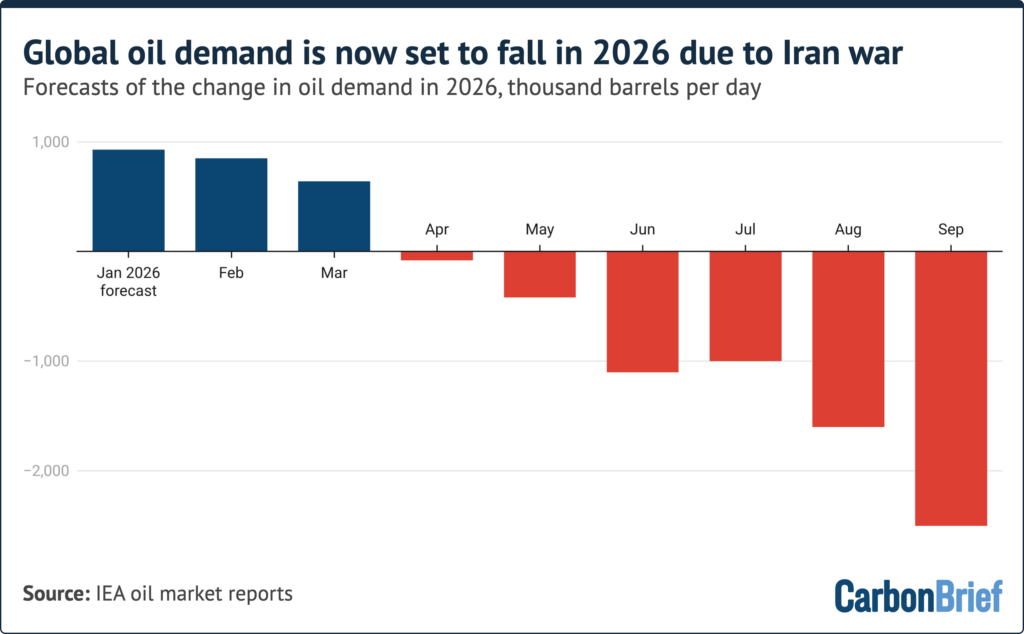
In its January 2026 oil market report, the IEA forecast a rise in demand in 2026 of 930,000 barrels per day (bpd). As shown in the figure below, this has been steadily revised downwards over the course of the year, as the Hormuz crisis was first ignited – and then extended.
By September, the IEA was forecasting a 2,500,000bpd drop in oil demand in 2026, equivalent to a reduction of 2.4% from 2025 levels.
(A 15 September research note from Morgan Stanley, not available online, found a “consensus” forecast of a 2,415,000bpd drop in demand in 2026.)
While there are many short-term factors at play in the shifting forecasts for 2026, it is clear that the latest energy crisis will also affect fossil-fuel demand in the next year and beyond.
For example, whereas the IEA initially forecast that oil demand would rebound in 2027 to well above 2025 levels, it is now expecting use of the fuel to be effectively flat for two years.
This puts a question mark over its previous expectation – published in October last year – that global oil demand would not peak until as late as 2030.
“For every month the conflict lasts, the probability of permanent [oil] demand destruction increases,” wrote Sverre Alvik, vice president at consultancy DNV in a late August analysis.
As fuel prices have surged, electric vehicles (EVs) have captured record shares of major car markets, from Australia and China through to Europe, Indonesia and Thailand.
In July, EV sales nearly doubled year-on-year in “new markets”, noted Alvik, pointing to countries outside China, Europe and North America.
The IEA says the 2027 outlooks for coal and gas are interdependent, with coal demand potentially increasing again if gas prices remain elevated – or dropping back if gas prices ease.
At the same time, governments in countries that had planned to rely on imports of liquefied natural gas (LNG) have been signalling shifts towards favouring domestic clean energy instead – or continuing to use coal for longer.
The current crisis, therefore, has the potential to not only lower fossil-fuel use and emissions in the short term, but also on a more lasting basis.
Related

CCC: Heathrow expansion could push flights to ‘80% of UK emissions by 2050’
Analysis: China’s CO2 emissions fall in Q2 2026 due to plummeting oil use
Explainer: The CMIP7 emissions scenarios – and how they explore future climate change