Sudan’s Comprehensive Peace Agreement, signed in 2005, seemed to vindicate a model for how wars might end in the Horn of Africa. Under the auspices of the African Union, led by hegemonic Ethiopia and backed by the United States, it wrangled the government and the Sudan People’s Liberation Movement/Army to the table with the promise of redistributing oil rents, and set the pathway for southern Sudan’s eventual secession in 2011. It had many faults, not least the failure to incorporate Darfurian groups and others, but it nevertheless held. It depended, however, on a coherent external coalition of powers with sufficient leverage, combined with domestic elites willing to negotiate and enough cash to secure a coherent deal. None of those conditions holds today.
Much has changed in the Horn of Africa in the two decades since it was signed in Naivasha, Kenya. War has returned to Sudan, Ethiopia has plunged into large-scale conflict and lost its regional sway, even as Somalia remains mired in another iteration of its civil war, and the wily Isaias Afwerki remains ever influential in his Eritrean kingdom. But the Horn has shifted from a state-centric conflict system–where wars ended through negotiations offering power-sharing and revenue—to a transnational war economy where state capture is no longer necessary.
Geostrategic tensions, principally between Saudi Arabia and the UAE, but increasingly involving Israel, Türkiye, and Iran, have drawn the Horn into a cascading series of conflicts. Transnational conflicts have substantial, underappreciated precedent in the region, but the scale and intensity now represent a distinct intensification. Fresh proxy wars have erupted along new and old battle lines, spurred on by arms and money from Ankara, Doha, Riyadh, and particularly the bullish UAE. At the centre sits the spiralling Sudan conflict, with the Emirates constructing supply lines for the RSF from Libya to Ethiopia and several foreign patrons arrayed behind the Sudanese army, particularly Saudi Arabia, Egypt and Türkiye.
Much of the analysis of the Gulf-Horn of Africa relationship has focused on the patrimonial dynamics between the clients and patrons and the temporary alignments that have formed and broken apart over the past decade. But perhaps more interesting is whether what is happening in the Horn reflects an older logic of predation, backed by contemporary technology and Gulf architects, or evidence of something more structural amid the breakdown of the sovereign order in the Horn of Africa.
The ‘state’ in the Horn remains, but its economic and military architecture has been progressively co-opted by foreign patrons, be it the UAE-linked ports in Puntland and Somaliland or the Turkish military rewiring of Ethiopian and Libyan security with drones. Nearly every central authority in the Horn increasingly competes for political rents and influence with transnational networks of armed groups, commercial actors, and foreign patrons whose interests are sustained by conflict. In turn, the proliferation of sub-national armed actors able to project devastating force from the peripheries – increasingly with drones – has altered the logic of conflict itself.
The Horn now faces a transformed conflict system in which the boundaries of war and peace, state and non-state, and domestic and external are breaking down, and in which new conflicts are perilously absorbed into existing transnational war economies.
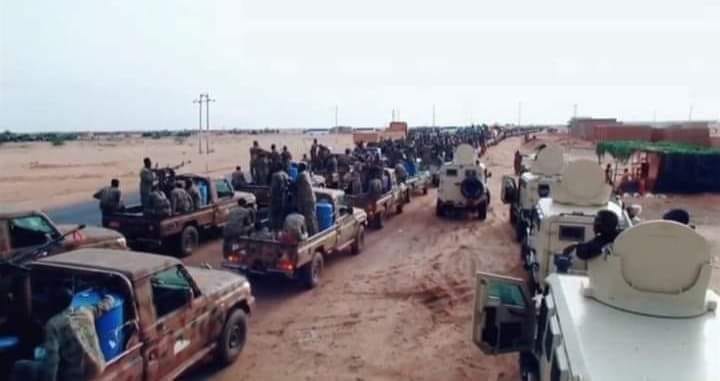
SAF reinforcements approaching Khartoum at the start of the current war in Sudan (2023).
Spatial collapse and transnational war economies
With each conflict theatre in the post-Pax Americana Horn of Africa and Middle East increasingly interwoven, escalations in one are metastasising across the system. The aftershocks of the US-Iran war are already washing up on the Horn’s shores, beyond the surging fuel and fertiliser costs. Competing coalitions spearheaded by Egypt, Saudi Arabia, and Türkiye on one side and the UAE and Israel on the other have hardened as they jostle for supremacy along the Red Sea, whose importance has surged following the near-total closure of the Strait of Hormuz. Recent Iranian-backed Houthi attacks on infrastructure in Saudi Arabia and transiting vessels point to the fragility of the order along the waterway. Even the consensus that underpinned the protection of international maritime navigation for global trade – expressed in the suppression of Somali piracy in the late 2000s – has been upended by American adventurism in the Middle East.
The regional conflict system has now reached a threshold at which any new war is rapidly absorbed and amplified by the existing architecture of foreign patronage and transnational war economies. Fears surrounding a potential conflict between Tigray, Eritrea and Ethiopia are instructive here, with observers concerned about the impossibility of containing any such conflict rather than about the consequences of a confrontation in isolation. A new war – with northern Ethiopia teetering on a knife-edge amidst recent probing attacks in Tigray –would acquire the same self-sustaining, multi-patron logic that has made Sudan’s war resistant to resolution, given its overlap with the Saudi-Emirati feud as well as Addis’s increasingly forthright role in facilitating cross-border RSF support.
But the blurring of peace and war extends across the Horn. South Sudan and Ethiopia are both sites of contested peace accords where diffused violence persists. Years-long insurgencies in Ethiopia’s most populous regions of Oromia and Amhara show no sign of abating, hollowing out state control and straining any monopoly of force exercised by Addis as the government faces a coalescing of domestic and regional opposition. Somalia, too, faces the twin pressures of Al-Shabaab and political fragmentation, with a rising tide of armed hostilities between the centralising Turkish-backed Mogadishu administration and arrayed peripheral actors—including the Emirati-backed Puntland and Jubaland—that increasingly look to foreign patrons rather than Mogadishu for security and economic opportunity. The political settlements that historically anchored these states are fracturing.
With economic and humanitarian crises gripping each of these countries, the splintering of domestic political settlements, and the proliferation and promise of Middle Eastern cash, one traditional pathway to peace – as seen in the CPA – of bringing armed actors into the state with the offer of power and revenue is becoming increasingly impossible to deliver. As states and sub-national actors accrue wealth and arms at alarming speed from Middle Eastern powers, the lure of a state’s diminishing spoils is fading.
The RSF is emblematic of such changes. A sweeping hybrid political-military-commercial enterprise, its transnational war economy stretches from Dubai to Benghazi in Libya. Shielded by the UAE, the RSF has committed innumerable war crimes and faced accusations of genocide against Darfurian communities, but can endure because of the flows of bullion and weapons, whilst what remains of a beleaguered ‘international community’ averts its gaze. And the RSF is just one of several subnational actors operating outside state lines, be it the proto-states of Al-Shabaab and the Houthis, or the Emirati clients of Somaliland and southern forces in Yemen.
In sum, political authority in the Horn is being refashioned into a sweeping interconnected system across the Red Sea and Gulf of Aden, binding increasingly fragmented territories into a self-reproducing regional conflict system.
Drones, and coercive power
Drones are the technology that helps make this transformation possible. The Horn’s conflict system is being further remade by the growing proliferation of drone technology in state and non-state hands – again supplied by predominantly Middle Eastern powers. Medium-altitude long-endurance (MALE) drones furnished by the UAE and Türkiye have become routine in Somalia, Ethiopia, and Sudan, helping to reshape the political economy of coercion by providing a qualitatively different fiscal and political alternative to committing ground forces.
MALE drones have already played central roles in the Tigray war, and in Sudan. Ankara and Abu Dhabi’s provision of drones to Addis in 2021, including Chinese Wing Loong 1s and Bayraktar TB2s, helped force the Tigrayan rebels into retreat, whilst civilian targets across the region were indiscriminately targeted. At the time, the Tigrayans had no defence and were unable to guard against the strikes. Recent reports suggest, however, that the TPLF – now allied with Eritrea – will not repeat such a vulnerability, and is sourcing its own drone and anti-drone technology.
Sudan has since become the fuller demonstration of the drone model, with both sides wielding Unmanned Aerial Vehicles (UAVs) to immense devastation-– at least 1,000 civilians were killed in the first months of 2026 alone. The Sudanese army was able to retake Khartoum in 2025 aided by the widely favoured Turkish Bayraktar drones as well as Iranian Qods Mohajer-6, and has now controversially deployed them in cross-border attacks targeting RSF supply lines in Chad. The UAE, on the other hand, has fashioned the paramilitaries with considerable UAVs as well, who have relentlessly tyrannised towns and cities across Sudan with incessant, indiscriminate drone strikes, not least during their siege of El Fasher, pummelling the city before overrunning it in October 2025.
So, too, are drones feeding into the ‘grey conflicts’ of the Horn, with deniable, unattributed strikes increasing, including Turkish operations off Puntland’s coast and Ethiopian strikes near Mekelle in the past fortnight alone, becoming a favoured weapon for those seeking plausible deniability. In Somalia, concerns are particularly growing around the purported strike from Turkish air assets on a former opposition-allied military commander; not the jihadist targets as promised.
The technology further upends the directional logic governing relations between armed actors and the state. The great armed movements of the late twentieth century in the Horn—including the TPLF and the Sudan People’s Liberation Movement/Army—regarded the state as the framework through which sovereignty could be exercised, with violence oriented toward capturing it. Even in 2021, the TPLF sought to bring low the Abiy government.
But as Sudan has revealed, drones have partly severed that assumption. A non-state actor no longer needs to seize the centre if it can strike from afar, supplied by external patrons immune to diplomatic pressure. Following their ejection from Khartoum by the Sudanese army, a flurry of RSF drone strikes on Port Sudan in May 2025 underscored the continuation of war by other means, with the former state paramilitaries degrading military assets from a distance. Keeping one’s enemies from the city gates is an altogether more complex proposition in 2026 than in previous decades.
Not all drones are MALE, however. And it is the Iranian-backed Houthis who have most radically pioneered low-cost, high-impact drone deployment as a military and political instrument, turning them against Red Sea shipping—first Israeli-linked shipping, now Saudi interests—since 2023. Their reach, too, is expanding across the Horn, developing non-state to non-state ties with predominantly Islamist movements, including army-linked Sudanese groups and Al-Shabaab. Military expertise and technology moving horizontally between non-state actors and proto-states, rather than simply downward from states, represents another shift in the Horn’s conflict theatre. The Houthis have demonstrated that a non-state actor can impose strategic costs on global commerce and constrain the military options of vastly more powerful adversaries, including the US and Israel– lessons eager to be adopted by other armed groups.
Permanent conflict
Whether we frame these as ‘new wars’ or continuities of older conflicts, the decisive shift is in the structure of incentives. The state-centric settlement mechanisms that historically ended Horn conflicts become far less effective when armed actors gain access to alternative sources of supply outside state structures.
The conflict system now operating across the Horn functions as a series of interconnected war economies of various kinds, not the temporary militarisation of state resources for a declared conflict, but the structural embedding of predation and armed competition as the baseline political logic. The gap between juridical and empirical statehood – which the post-colonial order papered over and the liberal peace managed at the margins – is now being torn open by actors with the resources and interest to exploit it. No single mediator has the leverage to impose a settlement from above, with the US ever less interested in exerting influence over its Gulf allies and consumed by the aftermath of its war with Iran.
This is not a passing phase of instability but a structural recalibration of politics, with wars becoming harder to contain, distinguish from peace, and end.