The Democratic party has won both chambers of US Congress in the midterm elections, wresting control from the Republicans. With Donald Trump still in the White House until 2028, the result has raised expectations of political gridlock.
Analysts at the US investment bank Stifel, for example, have predicted that gridlock is “the most likely policy outcome”. Ahead of the elections, Trump warned he would block all legislation sent to him by a Democrat Congress, saying he might become “Mr Veto”.
He has since softened his tone. On election night, Trump told journalists he was “absolutely willing” to accept the results, adding: “We’ll work with the Democrats, and we’ll, you know, look forward to working with them.” He has still promised to use his presidential veto for “things that are insane”.
History casts doubt on the gridlock prediction. Our analysis of past US Congresses suggests that, while losing both chambers means more opposition for the president, it could also reduce partisan friction between the House and Senate.
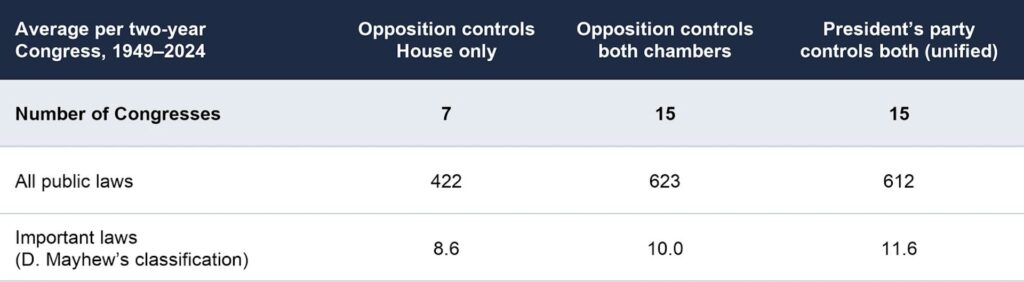
Since 1949, the opposition has controlled only the House in seven Congresses, compared with 15 in which the opposition has controlled both chambers. In another 15, the government was unified, with the president’s party controlling both.
As shown in the figure, opposition control of both chambers need not mean less legislation. Opposition-controlled Congresses have passed roughly as many laws as unified ones, and more “important” laws than those in which the opposition controlled only the House.
These important laws come from political scientist David Mayhew’s 1991 list of laws that journalists covering Congress judged significant at the time.
The raw figures can be misleading. Lawmaking has declined over time, from an average of about 840 laws per Congress between 1949 and 1960 to about 330 between 2011 and 2024. Most House-only Congresses are also relatively recent.
But accounting for this trend, opposition-controlled Congresses passed around 15% more laws and a third more important laws than House-only ones.
Two presidents have gone from facing an opposition House alone to facing opposition in both chambers. When Democrats gained control of the Senate in 1986, giving the party control of both chambers, laws passed under President Ronald Reagan rose from 664 in one Congress to 713 in the next. Important laws rose from nine to 12.
After the Republicans, who already held the House, took the Senate in 2014, laws passed under President Barack Obama also rose. They increased from 296 in one Congress to 329 in the Congress after the midterms. Important laws rose from ten to 12.
The type of legislation also matters. Data from earlier research shows that the number of domestic laws passed differed little between Reagan’s years of House-only opposition and years when the opposition held both chambers – 145 a year against 158.
But foreign policy laws (25 per year on average against 44) and important domestic laws (5.5 against 8.4) were more numerous when the opposition controlled both chambers.
These historical patterns are descriptive rather than causal, and “important” laws are not necessarily good laws. Still, they give little support to the idea that a second opposition chamber necessarily means more gridlock.
Why a second chamber might help
Joe Biden’s final two years in office illustrate the problem with a split Congress. After the Republicans won the House in the 2022 midterms, while the Democrats retained control of the Senate, the number of laws passed fell from 362 in 2021-22 to 274 in 2023-24. One party controlling both chambers can stop bills from stalling between them before they reach the president.
A 2025 study examined public opinion on 103 key bills before Congress between 2006 and 2022. Among 27 issues that were popular with voters of both parties, such as the Violence Against Women Act and the 2021 US$1.2 trillion (£890 billion) infrastructure bill, Congress did what a majority of people wanted 67% of the time when the same party held both chambers. This compared with 42% when control was split.
American political scientist Sarah Binder, studying the period between 1947 and 1996, likewise found that House-Senate disagreements were a major source of gridlock. She measured gridlock as the share of major issues, identified from New York Times editorials, on which Congress failed to act.
Agreement between the House and Senate is only half the battle. Even if Democrats pass legislation through both chambers, Trump can veto it. Overriding him would require two-thirds in each – far beyond the Democrats’ current majorities. But vetoing everything could leave Trump with little to show for his final two years.
Trump has also so far relied heavily on executive orders. By late October, he had issued at least 292 since returning to office in January 2025, compared with 220 in the whole of his first term and 162 under Biden.
Congress has powers beyond legislation. A 2008 study found that opposition control of the House increases congressional investigations, and a Democratic Senate could launch its own. If the House impeached Trump or one of his officials, the Senate would hold the trial, though conviction requires a two-thirds vote from the senators present.
The consequences of these midterm electoral results could extend abroad. Further aid to Ukraine requires congressional funding and presidential cooperation. The Senate also approves senior appointments, including ambassadors and national security officials and consents to treaties. This gives the Democratic majority some say over foreign policy.
In a recent working paper with Matia Vannoni, we find evidence that institutional checks on populist leaders, such as an independent civil service, may limit the economic damage they cause. A Democratic Congress could provide another counterweight to the president through stronger oversight.
That, rather than the number of laws passed, may be the election’s most consequential result.
The authors do not work for, consult, own shares in or receive funding from any company or organisation that would benefit from this article, and have disclosed no relevant affiliations beyond their academic appointment.