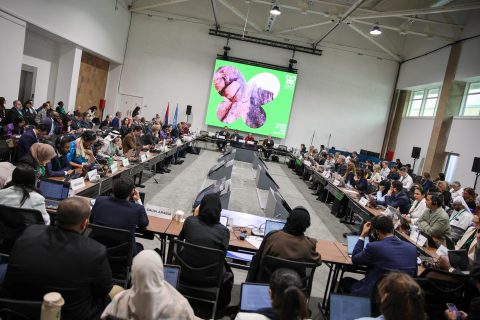
Governments at the COP17 nature summit in Armenia agreed on Saturday to scale up their policies to protect the planet’s shrinking biodiversity, and for the first time invited large emerging economies like China and Gulf states to take on donor responsibilities to help fund those efforts.
For the past two weeks, countries held talks in Yerevan under the UN Convention on Biological Diversity to outline a plan to ramp up currently “insufficient” policies to conserve land and marine ecosystems. A recent UN progress report found the world is off track to meet 22 out of 23 global targets aimed at reversing species loss and protecting 30% of land and seas by 2030.
While a response plan, called the “Global Review of Collective Progress”, was expected to be the main outcome of COP17, negotiations struggled to advance amid a deadlock over the controversial subject of how to finance the boost in conservation measures needed.
After an all-night session on Friday, delegates agreed to invite developing countries to voluntarily signal their interest in assuming donor funding obligations alongside developed nations. Negotiators repeatedly warned that any stronger provisions on expanding the donor base would collapse the deal.
COP president: Results beat expectations
An exhausted COP17 president Hambardzum Matevosyan, Armenia’s environment minister, told journalists in the early hours of Saturday that “we’ve achieved more than we could’ve expected” given the “importance” of the decisions being taken.
“It was 100% possible that those items did not made it through. 100% possible,” he said, adding that the conference had made progress on “all the most important items”.
Speaking at the closing plenary, the group of Pacific Islands said that, while the summit had achieved “great outcomes”, delegates are also departing Yerevan “with realities not reflected in the official text”, such as the low replenishment of the Global Environment Facility (GEF), a key funder of nature projects.
Some observers also said the deal did not go far enough. Steven Guilbeault, a former Canadian environment minister who helped broker the Global Biodiversity Framework (GBF), said the Yerevan package of action is “an important step forward”, but still “falls short of what is needed to meet our 2030 commitments”.
An Lambrechts, biodiversity politics expert at Greenpeace International, said COP17 had kept things moving forward and set well-intentioned promises, but added that these “won’t remove major roadblocks to implementation” such as insufficient finance and debt constraints in developing countries.
WWF chief conservation officer Daudi Sumba noted that financial issues were not fully resolved. Despite the deal in Yerevan, “I fear finance will remain the key issue that continues to haunt the UN biodiversity summits,” he said in a statement.
‘Yerevan Pathway’ tackles nature plans and subsidies
In the lead-up to the summit, the UN assessment report showed countries are falling short on virtually all targets in the GBF, the 2022 global deal often referred to as the ‘Paris Agreement for nature’.
They include a landmark target to protect at least 30% of the planet’s land and sea by 2030. If countries all stick to their current national goals, about 26% of land would be protected and only about 12% of marine ecosystems would be under conservation measures.
The main COP17 decision – named the Yerevan Pathway by the presidency – calls for countries to revise their biodiversity plans, subject to available funding, with a particular focus on addressing the gap in coverage of “marine, coastal and inland water ecosystems”.
It also urges the over 60 countries who have not submitted a biodiversity plan yet to finalise them “as soon as possible” and taking into account the gaps identified by the UN progress report.
Countries also agreed to tackle the drivers of biodiversity loss by “accelerating” the reduction of subsidies for activities that damage nature. Subsidy reform, covered by Target 18 of the GBF, is where countries have made the least progress so far, according to the assessment report.
Jill Hepp, director of nature and marine policy and incentives at green group Conservation International, said singling out subsidies in the Yerevan Pathway “gives a strong signal” that closing the gap for biodiversity action requires “more urgent efforts to reform harmful incentives and scale up positive incentives”.

“Timid” steps to expand base of donors
Having failed to meet a target to channel $20 billion for biodiversity conservation by 2025 and faced with shrinking aid budgets, the EU pushed a proposal to expand the list of which countries count as donors, so that wealthy emerging economies like China and Saudi Arabia could also voluntarily contribute. The group of Arab nations strongly opposed this.
During the talks, Irish minister of state for nature, Christopher O’Sullivan, whose country holds the EU presidency, said the bloc wanted the world’s “new realities” to be reflected in the donor list.
Negotiations remained gridlocked for most of the two-week talks, until a last-day compromise was struck to invite developing countries that may want donor status “to indicate to the [Convention on Biological Diversity] secretariat their interest in being included in the corresponding list”.
Countries also asked the secretariat to send an invitation to emerging economies wanting donor status at each subsequent COP, and requested a technical report on “the implications of inclusion in the list” for emerging economies.
Swiss lead negotiator Gabriela Blatter said during one of the sessions that her country had expected greater steps towards expanding the base of contributing countries, but added that “if we’re mutually unhappy, it’s probably the closest we can get on these very delicate political compromises”. Saudi Arabia, on the other hand, also noted their dissatisfaction but said it had expected “a lot less”.
The fragile deal was approved in a package of decisions together with the Global Review, after some delegations including Brazil and China appealed to the plenary not to make further changes to the text at the risk of collapsing the whole agreement.
In a statement delivered to the closing plenary, the EU said the finance outcome had delivered “timid” progress towards fully broadening the base of donors.

Cali Fund still not operational
Adopted two years ago at COP16, the Cali Fund was seen by some observers as a way to channel private-sector finance into biodiversity conservation, as governments struggle to find public funds. But it is still struggling to get up on its feet.
The fund allows big corporations to access certificates for the use of genetic material found in biodiversity in return for a financial contribution, which experts estimate has the potential to raise up to $6.9bn for biodiversity. While voluntary, companies are encouraged to pay 1% of their profits or 0.1% of revenue into the fund.
But since its creation, the fund has received little more than $10,000, which Guilbeault argued is because the rules for disbursements to local communities and the operation of the fund had yet to be fleshed out. This was due to happen at COP17.
Yet, while the final decision on the fund laid out some of the rules – including how companies can earn “Cali Fund certificates” – some key technical details were left to the next COP in 2028 in Ecuador. This includes the issue of whether companies can pay a lower rate if they use genetic data for only a small portion of their products.
“By punting essential decisions to two years from now, parties have all but ensured the fund remains empty until then,” said Pakhi Das, a public policy advisor at NGO Plant-for-the-Planet.