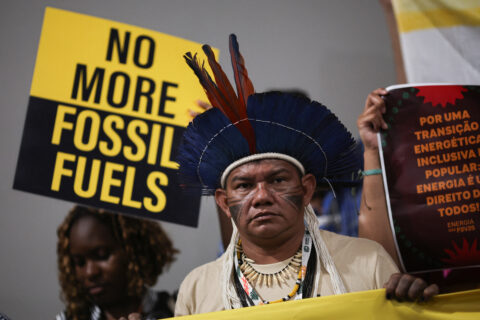
Some governments have backed using Brazil’s voluntary roadmaps on fossil fuels and deforestation to inform the next UN assessment of global climate action, a key process that concludes in 2028, the COP30 presidency told Climate Home News.
Brazil published the roadmaps on transitioning away from fossil fuels and on halting deforestation by 2030 this week, after failing to secure an agreement in Belém to make them part of formal negotiations. The documents set out a menu of policies countries could use to start acting on both issues straight away.
At their launch, Brazilian top climate officials argued the roadmaps could feed into the second stocktake negotiations. Through that process, due to start at this year’s COP, countries are meant to take stock of collective progress on climate action and decide on a plan to ramp up ambition in future policies.
In an interview with Climate Home News in London, COP30 president André Corrêa do Lago said that “some European governments” had signaled their support for the Brazil-led roadmaps to inform the global stocktake negotiations.
“I hope that there will be many other countries that may support this,” he said. “It’s not that you have to take the entire package, because who are we to come up with the solution? But some elements of the roadmaps may be useful.”
-
COP31 Briefing: What to expect from the Antalya climate summit?
Electrification, the fossil fuel transition, adaptation to rising impacts, climate science and trade are key themes as governments gather for COP31 in Türkiye

Corrêa do Lago cautioned that countries might not publicly come forward to champion the lengthy documents at COP31, because “governments have to read [the roadmaps] and they have to be very careful”.
The fossil fuel roadmap invites countries to draw up their own domestic plans to cut fossil fuel use and production and build clean energy systems by 2028, while putting the main push on cutting coal, oil and gas supply after 2031. The deforestation roadmap urges countries to use existing tools to ramp up finance and forest monitoring, and to tackle harmful trade incentives, among other measures.
Santa Marta coalition could put roadmap to use
As his presidency draws to a close, Corrêa do Lago said Brazil would keep championing the roadmaps but that “others will decide” whether they are taken up in the formal UN negotiations. Those talks, where decisions require consensus among nearly 200 countries, might not be the best venue, he added.
He suggested a potential home for the fossil fuel roadmap, outside of the UN negotiations, could be the Santa Marta process. A group of nearly 60 governments met for the first time in April in Colombia to discuss how to wean their economies off fossil fuels.
Countries in Santa Marta signaled their interest in developing national roadmaps away from fossil fuels, as well as building trade systems that favour renewable energy and reforming global finance to remove barriers to the energy transition.
Corrêa do Lago said the coalition “can have a very important role” in putting the fossil fuel roadmap to use, because its members are already focused on implementation and could use the roadmap and “even perfect it”.
Clean power shields China from oil shock more than any other country
UK says there’s no time to waste
Speaking alongside the COP30 president at an event in London, UK climate envoy Rachel Kyte said the transition away from fossil fuels was “in danger of becoming just a slogan”. She praised Brazil for “helping us turn it into a planning principle” despite the lack of consensus in the formal UN talks.
But Kyte added that the speed at which countries constrain fossil fuel supply was “critical”. Pointing to soaring oil and gas prices, which have put energy policy at the centre of debate in countries such as the UK, she said: “I don’t think we got time to wait until the early 2030s.”
Brazil is among the countries still planning an expansion of oil and gas exploration, with recently re-elected president Lula da Silva saying recent discoveries near the Amazon river could be “a passport to the country’s future”.
Kyte added that the UK “would come right behind this roadmap and agree that you have done something diplomatically that we needed”, and said it is important for COP31 co-presidencies Australia and Türkiye, as well as COP32 president Ethiopia, to “find a way to move this forward”.