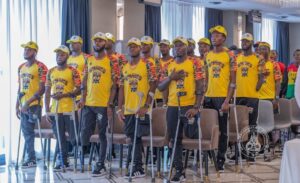
The Black Challenge has won African titles, an African Para Games gold medal and a place at the 2026 Amputee Football World Cup. Yet weeks before leaving for Mexico, where they will face Angola, Colombia and Iraq in Group D, Ghana’s national amputee football team is still appealing for financial support.
This is the paradox at the heart of Ghanaian para-football: a team successful enough to bring international recognition and national pride, but not yet supported by a sporting system strong enough to make that success sustainable.
The appeal came at the team’s unveiling in Accra on September 28, where the president of the National Paralympic Committee Ghana (NPC-Ghana), Samson Deen, called on the government to settle outstanding bonuses and per diems and allocate at least 5% of the Black Stars budget to amputee football.
At the same event, NPC-Ghana announced bonuses of GH¢10,000 for each player and GH¢5,000 for each official under its “Target the Podium” initiative.
Deen also said the Black Challenge “deserves everything that sports winners win for the nation.”
The issue predates the current World Cup campaign. In May 2024, captain Richard Arthur Opentil publicly raised concerns about outstanding bonuses and inadequate support while the team competed at the Amputee Africa Cup of Nations in Cairo.
In a phone interview on October 17, 2026, Opentil said the two winning bonuses remained outstanding: one for the Para Games and another for the Africa Cup of Nations in Egypt. “We have two outstanding bonuses to collect from the government,” he said. He added: “I think when you win, the state needs to reward you.”
When asked if visibility has brought the team any form of support, he offered a qualified answer. “Financial wise, yes and no… We’ve been partially rewarded, but not fully,” he said.
At the Black Challenge’s unveiling ahead of the 2026 World Cup, Minister of Sports and Recreation Kofi Adams said he has asked the team’s leaders to submit documentation so that the government could follow up on pledges and promises “that have been made verbally.”
The event also brought some financial commitments. According to Modern Ghana, Gold Fields Ghana pledged US$500,000 in support of disability sport, with US$250,000 earmarked for the group’s World Cup preparations.
On May 8, 2026, Gold Fields Ghana and the Ghana Football Association (GFA) announced a two-year partnership worth US$5 million. The agreement covers the Black Stars, Black Queens, Women’s Premier League and Black Challenge. According to the GFA announcement, the partnership is expected to promote “inclusivity through dedicated support for the Black Challenge”, but it does not specify how much funding the team would receive.
Reports of the September unveiling do not explain how the US$500,000 pledged relates to the wider US$5 million partnership.
In a phone interview on October 20, the Secretary-General of the National Amputee Football Association of Ghana, Mohammed Harmis Muzair, explained that there was an understanding that the Black Challenge would receive US$500,000 from the wider partnership. Because the team was not directly involved in negotiating the sponsorship, requests for funding had to go through the GFA, which would review its proposals before forwarding them to KPMG, which Muzair described as the administrator of the funds.
“As we have been talking, we have not received even a dime from the money yet,” Muzair said. He added that the GFA had provided footballs, training jerseys and other clothing, while efforts were ongoing to make funds available for the team’s expenses.
Opentil also explained that although Gold Fields Ghana had made a provision towards the team’s preparations, the team’s administrators were writing formally to request the funds. “[Gold Fields] has made a provision for us, but you know it is a process and you need to write to them for them to pay the money… Our administrators are formally writing.”
At community level, the gap between policy commitments and sporting opportunities remains a concern. Research on disability sport in Ghana identifies inadequate funding, limited access to appropriate training facilities and equipment, and weaknesses in the implementation of inclusion policies.
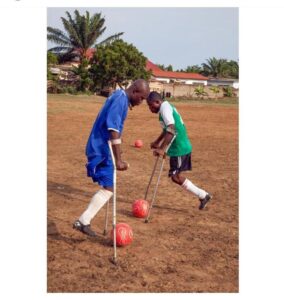
Para-athletes can find themselves training on rough dirt pitches, open school fields and improvised spaces that are not designed with disabled athletes in mind.
Ghana’s legal framework recognises responsibilities towards accessibility and sport. The Persons with Disability Act, 2006 (Act 715), provides for accessibility, while the Sports Act, 2016 (Act 934), assigns responsibilities to District Sports Units that include the development and maintenance of sporting facilities and the promotion of Paralympic sport. The issue, then, is not simply whether Ghana has policies on paper. It is whether those responsibilities are visible in the sporting spaces where disabled athletes actually participate.
That question is also a question of governance. For 13 years, amputee football in Ghana was caught in a dispute over who had the legitimate authority to govern and recognise the sport. On July 30, 2026, the High Court’s Commercial Court 6 in Accra ruled in favour of the National Sports Authority (NSA) and the National Paralympic Committee Ghana (NPC-Ghana) in the case brought by the Ghana Amputee Football Federation (GAFF).
The court held that GAFF was not recognised by the NSA, NPC-Ghana or the World Amputee Football Federation (WAFF) and could not hold itself out as the lawful body responsible for overseeing amputee football in Ghana.
The ruling clarifies who is recognised to oversee amputee football, but legal authority alone does not guarantee funding, facilities or grassroots development. The question is whether the institutions responsible will provide the conditions needed to sustain participation.
Celebrated, but on whose terms?
The media does not simply describe disability; it helps shape how persons with disabilities are understood and what society expects of them. When sporting achievements are presented primarily as inspirational stories, admiration does not necessarily give athletes more say in how sports money is spent, what institutions prioritise or the conditions in which they compete.
The Black Challenge can be celebrated for its achievements without turning them into miracles. Its players are skilled competitors whose participation deserves investment and whose voices should inform decisions about their sport.
The danger in the politics of naming disability is that the language of recognition changes faster than the structures behind it.
Les Autres
The politics of naming disability also extends to the rules governing the sport. The World Amputee Football Federation’s (WAFF) published Laws and Rules, for example, recognises both “Amputees” and a category called “Les Autres” (French for “the others”),covering players who may not be clinically amputees but have a birth defect affecting a limb or an entire limb with no meaningful function. These definitions do more than describe impairment. They help determine who qualifies to participate in the sport and under what conditions.
Under WAFF’s Articles of Association, voting rights at the international level rest with one recognised national member body per country, rather than individual players. Inclusion is not only about celebrating athletes; it also raises questions about who sets the rules and how athletes can influence decisions shaping their participation.
The Ghana Sports fund test
The Ghana Sports Fund offers another test of whether Ghana can turn recognition into a more sustainable sporting system. Established under the Ghana Sports Fund Act, 2025 (Act 1159), the Fund says it supports athlete welfare, grassroots sport and infrastructure. When checked on October 29, 2026, its para-sports page listed zero funded athletes. It is early days, and this does not establish a failure to support para-football. Where the sport will sit within the new funding system remains an open question.
The Black Challenge’s World Cup campaign will bring renewed attention to Ghanaian amputee football. But the harder test comes afterwards: whether recognition translates into sustained funding, better grassroots opportunities, accessible facilities and a meaningful voice for athletes in decisions affecting their sport.
Ghana has already shown that its amputee footballers can win. The next question is whether the institutions around them can do more than celebrate those victories.