On Dennis Pritt Road in Nairobi’s Kilimani district, long queues formed outside the Burundian embassy on 7 September. People were waiting for laissez-passers, temporary travel documents enabling them to return home without valid passports. The embassy had offered to issue them free of charge. Early social-media reports also referred to Congolese nationals preparing to leave Kenya. None of those in line had necessarily received an individual deportation order. They were responding to something less formal but already powerful: the expectation that remaining in Kenya might soon become unsafe or impossible.
Five days earlier, President William Ruto had told representatives of micro, small and medium enterprises at State House that the government would act against foreigners engaged in hawking and small retail. Referring to legislation still before parliament, he argued that some economic activities should be reserved for Kenyans. He then moved from future legislation to immediate instruction: “Hawa wachuuzi ambao wanafanya biashara ndogo ndogo wafunge, na wasipofunga…” – these traders running small businesses must close, and if they do not… The unfinished sentence carried its own threat.
Ruto’s argument rested on a distinction between two kinds of foreign presence. Kenya had worked to attract investors who bring capital, factories and jobs, he said, not traders who compete with Kenyans at the bottom of the retail economy. He called for loopholes to be closed so that someone could not come from China to work as a hawker. The government also urged parliament to accelerate the Local Content Bill 2025, which seeks to raise Kenyan employment and procurement within foreign-owned firms.
By the eve of the announced crackdown, the government was trying to narrow the meaning of the president’s words. Trade Cabinet Secretary Lee Kinyanjui said visa-free entry does not confer a right to work or trade and that action would target people operating outside the conditions of their immigration status. Foreign Affairs Principal Secretary Korir Sing’Oei went further, insisting that foreign nationals with the required work permits and licences remained legally protected, whether their businesses were large or small. Kenya, he said, was still open to Burundians, East Africans and Africans more broadly.
This clarification matters, but it does not remove the contradiction. Ruto’s original distinction was not simply between documented and undocumented migrants. It was between foreign investors considered economically useful and foreigners occupying low-capital activities supposedly meant for citizens. Nor did he explain which businesses were too small for foreign participation, or the legal basis for closing them before parliament had passed the proposed law.
That ambiguity is especially dangerous in an economy where informality is not an exceptional condition. Kenyan citizens as well as migrants combine casual employment, street vending and small-scale trade, often working across uncertain boundaries of licensing and registration. If informality becomes intolerable only when practised by a foreigner, immigration status ceases to be the real criterion. Nationality becomes a proxy for deciding who is entitled to make a living.
The first consequences were visible before enforcement began. Videos circulating online showed confrontations with foreign vendors; in one, people appeared to take goods without paying. Burundi sought assurances for the safety of its nationals and raised concerns about harassment and mistreatment. Kenyan civil-society organisations warned that indiscriminate enforcement could encourage ethnic profiling, persecution and violence. The queues outside the embassy were therefore not merely an administrative response. They were evidence that political language had already altered migrants’ assessment of risk.
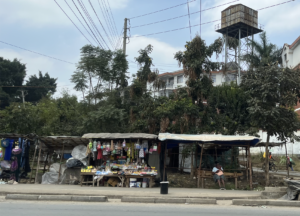
Street vendors in Nairobi 2025
This is where Kenya’s debate begins to resemble South Africa’s. South African xenophobia is often described as irrational hatred, but its public justification is frequently economic. Foreigners are accused of taking jobs, undercutting prices, occupying trading spaces or accepting conditions local workers cannot survive on. Migrant-run spaza shops and informal businesses have consequently become recurring targets of intimidation, looting and destruction.
The decisive shift occurs when enforcing immigration rules no longer belongs exclusively to public authorities. Neighbours demand documents, competitors order shops to close, and vigilante groups decide who may enter a market or use a public service. Movements such as Operation Dudula have turned this improvised border control into a political programme. South Africa’s major waves of xenophobic violence – notably in 2008, 2015 and 2019 – demonstrate how quickly claims about protecting citizens can become collective punishment of anyone perceived as foreign, including documented migrants and even citizens misidentified as outsiders.
Kenya is not yet South Africa. It does not have an equally established anti-migrant movement capable of mobilising across several cities. Nairobi remains a regional economic centre shaped by international organisations, refugees, investors and workers from neighbouring states. Yet these differences should not become grounds for complacency. The Kenyan directive activates the same dangerous sequence: genuine economic insecurity is attributed to foreign competition; a broad political statement legitimises exclusion; and citizens begin acting before the state has defined either the law or its limits.

Hawker
The policy also exposes a regional contradiction. Kenya, Burundi and the Democratic Republic of Congo are all members of the East African Community. The Common Market is intended to deepen the movement of people, labour, services and capital. EAC citizens remain subject to national licensing, tax and immigration requirements, but a general exclusion based on nationality would conflict with the political promise of regional integration. It could also provoke retaliation against Kenyan workers and traders elsewhere in East Africa.
Protecting Kenyan small businesses is a legitimate policy objective. Traders face weak purchasing power, unemployment, rising costs and intense competition for marginal incomes. But removing poorer competitors does not address the structures producing that scarcity. It converts a distributional crisis into a conflict between people with the least protection. The foreign hawker becomes a visible substitute for failures in employment creation, urban management and social policy.
The government’s clarification still offers a route away from escalation. Enforcement can be confined to transparent, individual assessments of permits and licences; officials can state unequivocally that civilians have no authority to inspect, threaten or evict traders; and EAC institutions can monitor whether regional citizens are being treated lawfully. Without those safeguards, the difference between immigration enforcement and xenophobic mobilisation may quickly collapse.
On Dennis Pritt Road, a South African-style campaign has not yet begun. But people queuing for papers were already behaving as though it might. Before the first official inspection, political language had identified the suspect trader, encouraged others to recognise him and shown him the road to the border.