By James Ogunnaike, Abeokuta
The International Fund for Agricultural Development (IFAD), in collaboration with the federal government and the Ogun State government, have reaffirmed its commitment to empowering women farmers and expanding their participation in agricultural value chains in the state.
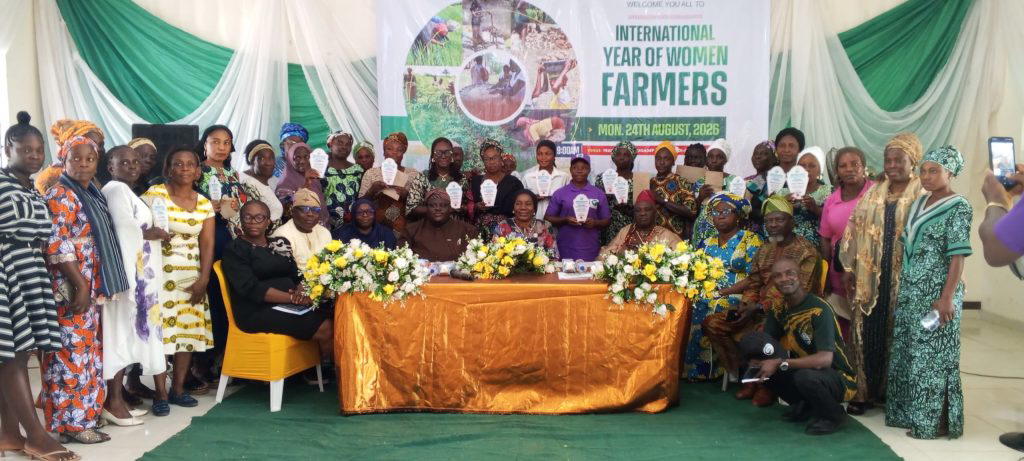
The commitment was made during a celebration of the International Year of Women Farmers, organised through the Special Agro-Industrial Processing Zones (SAPZ) Programme and the Value Chain Development Programme (VCDP).
The programme, held at the Training Hall of the Ogun State Agricultural Development Programme (OGADEP), in Abeokuta, provided an opportunity to recognise the resilience and contributions of women farmers to food production, household livelihoods, nutrition, food security and economic development.
Speaking at the programme, the Ogun State Commissioner for Agriculture and Food Security, Bolu Owotomo, represented by the Permanent Secretary in the Ministry, Mrs. Lydia Fajounbo, said the state government was committed to creating an enabling environment for women farmers to increase their productivity, improve their livelihoods and participate more meaningfully in agricultural value chains.
Owotomo said women remained indispensable to virtually every segment of agriculture, including crop and livestock production, processing, storage, marketing, value addition and household nutrition.
He, however, acknowledged that women farmers continued to face barriers such as limited access to land, finance, improved inputs, mechanisation, technology, extension services and markets.
He said the celebration should therefore go beyond recognition to the implementation of practical measures capable of removing the barriers and enabling women farmers to realise their full potential.
“This celebration must go beyond recognition. It must translate into practical interventions that remove the barriers confronting women farmers and enable them to reach their full potential,” he said.
According to him, programmes such as SAPZ and VCDP were creating opportunities for women to participate more effectively in production, processing, value addition, storage and market access.
He urged women farmers to embrace innovation, improved agricultural technologies, climate-smart practices, value addition and cooperative development, assuring them of the continued support of the state government.
Owotomo said empowering women farmers would have a multiplier effect on families and communities through improved household welfare, nutrition, education and economic opportunities.
He consequently called for stronger collaboration among government institutions, development partners, SAPZ, VCDP, private-sector operators and other stakeholders to build an inclusive, productive and profitable agricultural sector where women would not only participate but also emerge as leaders, investors and employers.
Also speaking, the Chairman of the Ogun State House of Assembly Committee on Agriculture, Waliu Owode, said the legislature was committed to providing stronger policy support for women farmers.
Owode noted that women constituted a significant proportion of smallholder farmers and made substantial contributions to food production through crop cultivation and livestock farming.
He said the state’s celebration of the International Year of Women Farmers provided an opportunity to strengthen policies and interventions designed to improve the productivity and welfare of women in agriculture.
The Gender, Youth and Nutrition Specialist, Country Programme Advisory Team (CPAT), Mrs. Saudat Zahradeen, urged stakeholders to move beyond celebrating women farmers, to creating practical opportunities that would enable them to thrive.
Zahradeen said empowering women farmers was critical not only to advancing gender equality, but also to strengthening food security, rural livelihoods and resilient food systems.
She noted that the International Year of Women Farmers offered an important platform for government, development partners, private-sector operators and communities to increase investments in women and ensure that agricultural programmes adequately addressed their specific needs.
In her remarks, the Acting State Programme Coordinator, Value Chain Development Programme (VCDP), Mrs. Abiola Shobukola, said the celebration provided an opportunity to recognise the critical role of women in agriculture and take deliberate steps towards addressing the barriers limiting their potential.
Shobukola said the programme reaffirmed the commitment of the Federal and Ogun State governments, IFAD and implementing partners to strengthening women’s participation in agriculture and ensuring that the benefits of agricultural development were inclusive, sustainable and accessible to women farmers across the state.
The State Project Coordinator, Special Agro-Industrial Processing Zones (SAPZ) Programme, Mr. Ibrahim Busi, said the celebration was an opportunity to recognise the pivotal role of women in agriculture while strengthening efforts to integrate them into Ogun State’s emerging agro-industrialisation ecosystem.
Busi explained that SAPZ was designed not merely to increase agricultural production, but to transform agriculture from predominantly primary production into a more integrated, commercially viable and sustainable agro-industrial system.
He said the programme was establishing stronger linkages among farmers, processors, aggregators, markets, infrastructure providers and private-sector investors.
According to him, women farmers were central to this transformation because of their significant participation in production, processing, aggregation, trading and household food systems.
“Deliberately integrating women into SAPZ value chains will create opportunities for them to move beyond subsistence farming into more profitable and sustainable agribusinesses,” he said.
Busi said the development of agro-industrial infrastructure and processing facilities would provide women farmers with opportunities to participate in value addition, processing, packaging, aggregation and market-oriented production.
He explained that agro-industrialisation could help address some of the major challenges confronting women farmers by reducing post-harvest losses, improving access to markets, strengthening linkages between producers and processors and creating opportunities to participate in higher-value segments of agricultural value chains.
He added that stronger farmer-to-market linkages would improve incomes, create employment and stimulate investment across the agricultural sector.
The SAPZ coordinator encouraged women farmers to organise themselves into strong and functional cooperatives, saying collective action would improve their access to agricultural inputs, finance, technology, extension services and markets while strengthening their bargaining power.
He also stressed the importance of private-sector participation in driving sustainable agro-industrialisation.
“Sustainable agricultural transformation requires a strong partnership among government, development partners, farmers, processors, financial institutions and investors. Women must not be positioned merely as beneficiaries of agricultural interventions; they must be active participants in the ownership, management and growth of agribusinesses,” Busi said.
He urged women farmers to take advantage of emerging opportunities in processing and value addition, stressing that the future of agriculture lay beyond the production of raw commodities.
According to him, developing competitive agricultural businesses capable of generating income, employment and wealth would be essential to achieving sustainable agricultural transformation.
He assured that SAPZ would continue to promote an inclusive approach to agro-industrial development by ensuring that women and other vulnerable groups were adequately considered in interventions designed to strengthen agricultural value chains and promote sustainable economic development.